
This analysis draws on data collected between February 2024 and February 2025 across major platforms, and centers on two key events in Al Jazeera state: the massacre in Wad al-Nura (June 2024) and the targeting of Al-Kanabi communities in (January 2025), and the subsequent violence in South Sudan. The report is part of ongoing efforts to understand and respond to digital harms and address online conflict dynamics in Sudan.
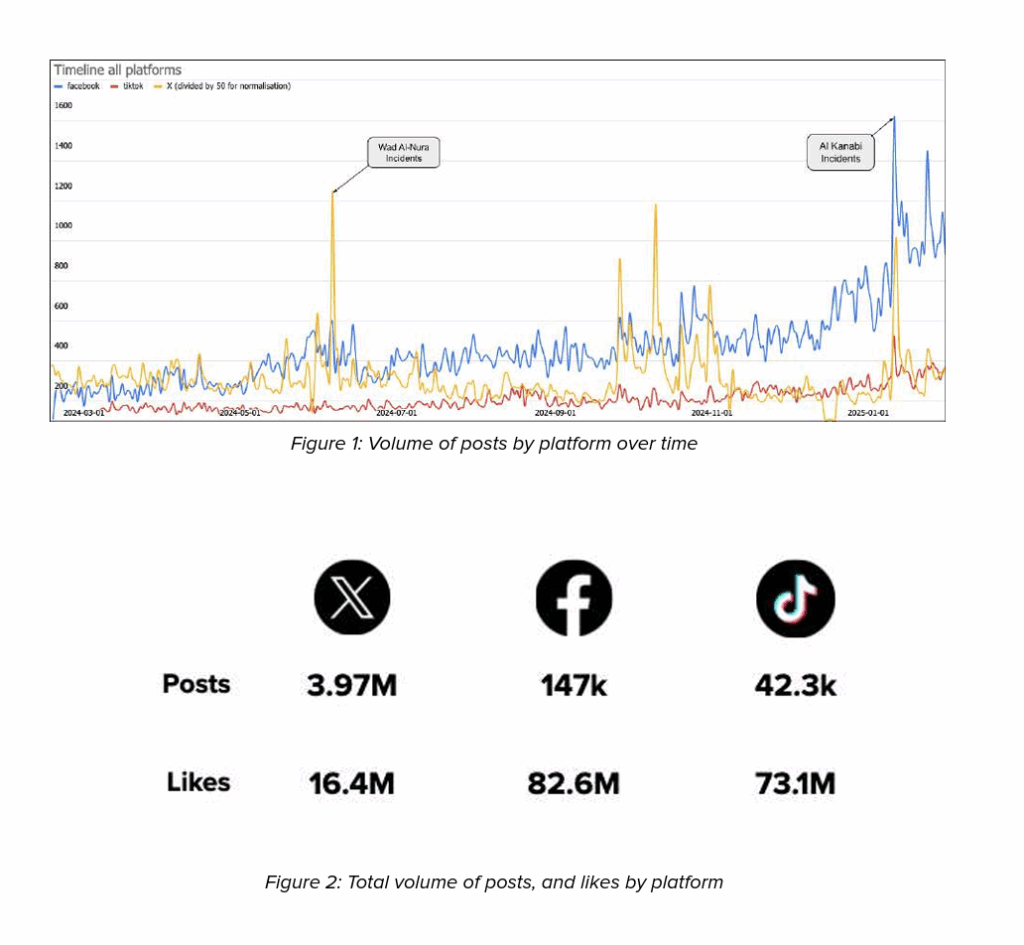
The findings in this article draw on social media data collected between February 2024 and February 2025 . 3.97 million posts from X, based on context-specific keywords; 147,000 posts from Facebook, using a combination of account and keyword tracking; and 42,300 TikTok videos, sourced from a curated list of accounts. We used feature-based classification to analyze the content. Classifications were guided by keywords related to the two main actor groups: the Sudanese Armed Forces (SAF) and the Rapid Support Forces (RSF). We also identified hate speech and violence-inciting content by using a lexicon that combines existing lexicons for hate speech in Arabic with context-specific terms. Other classifications were applied to identify references to tribes and regions. In addition, we developed a classification model based on the affiliation of the content author, assessing whether users appeared to support or align with SAF or RSF.
THE SOCIAL MEDIA BATTLEFIELD
Social media is central to the ongoing conflict, with both sides aggressively trying to control the narrative around the war. The RSF portrays itself as a democratic force fighting a state controlled by “northerners” and remnants of the former Islamist regime. They also have adopted a “center and periphery” discourse to claim that they are against the historical power imbalances and accuse northern/central Sudanese of dominating the country since independence in 1956—a system they refer to as ” ﺔﻟود ٥٦ ” (state of 56). SAF named the war the “War of Dignity.” This term was first used in marches called “بﻛاوﻣ ﺔﻣارﻛﻟا” “Marches of Dignity,” which were backed by the dissolved National Congress Party (previous regime) in order to support the outcomes of the military coup in October 2021.
The SAF narrative also redefines national identity, casting certain groups as non-Sudanese, claiming that RSF members were of West African origin, and casting them as outsiders. They also worked on positioning the civilian forces—the Forces of Freedom and Change (FFC) at the time—as a political backer of the RSF because they did not take their side in the war, spreading hashtags like #ﺔﺗﺎﺣﻗ_دﯾوﺟﻧﺟ which means the FFC is the Janjaweed/RSF, and hence claiming that the democratic civilian entities politically supported the RSF. They also promoted the concept of “social incubators,” suggesting that entire communities or tribes sympathize with or support the RSF, and therefore violence against them is justified. The impact of this narrative warfare – unfolding primarily on social media – is evident in the data we collected from February 2024 to February 2025, where we found 75,700 posts 6 containing hate speech across all three platforms monitored.
On Facebook alone, we found 3,740 posts, or 2.73% of all posts in this period, contained hate speech; 1,550 posts (or 1.13% of all posts) incited violence in that period. Figure 3 shows that hate speech on social media is most closely linked to al-Jazeera (5.3%), then Darfur (4.98%) and Khartoum (3.8%), which are areas where the military conflict was most intense. Online narratives manifest differently across platforms. Facebook is the SAF’s strongest platform, dominated by nationalist and militaristic narratives backed by legacy media and army-aligned influencers. Around 58% of content is generated by pro-SAF accounts, with emotional content—like tributes to soldiers and commanders—going viral. Civilian forces have low visibility, and RSF content is largely absent (most likely taken down by Meta). The RSF’s digital stronghold is TikTok, where short battle clips and emotive speeches frame its fighters as heroic. Key speeches by Hemedti and the February 2025 Nairobi conference boosted RSF-linked content. TikTok’s fast-paced, dramatic style aligns well with RSF’s media strategy.
Download the report (In English), (in Arabic)
Review following complaint